A family story · Blanchard line · 2026-09-29
New Three Sisters of Salem
Rebecca Nurse, Mary Esty and Sarah Cloyce, three daughters of William Towne accused of witchcraft in 1692, and the line that runs from their brother Jacob down to Nancy Jane Blanchard.
In the spring of 1692 three sisters from one Massachusetts family were accused of witchcraft and jailed. Two of them were hanged at Salem. They were Rebecca Nurse, Mary Esty and Sarah Cloyce, daughters of William Towne.
The family connection runs through their brother, Jacob Towne. Jacob was the eighth great-grandfather of Nancy Jane Blanchard (1929–2006), which makes William Towne her ninth.
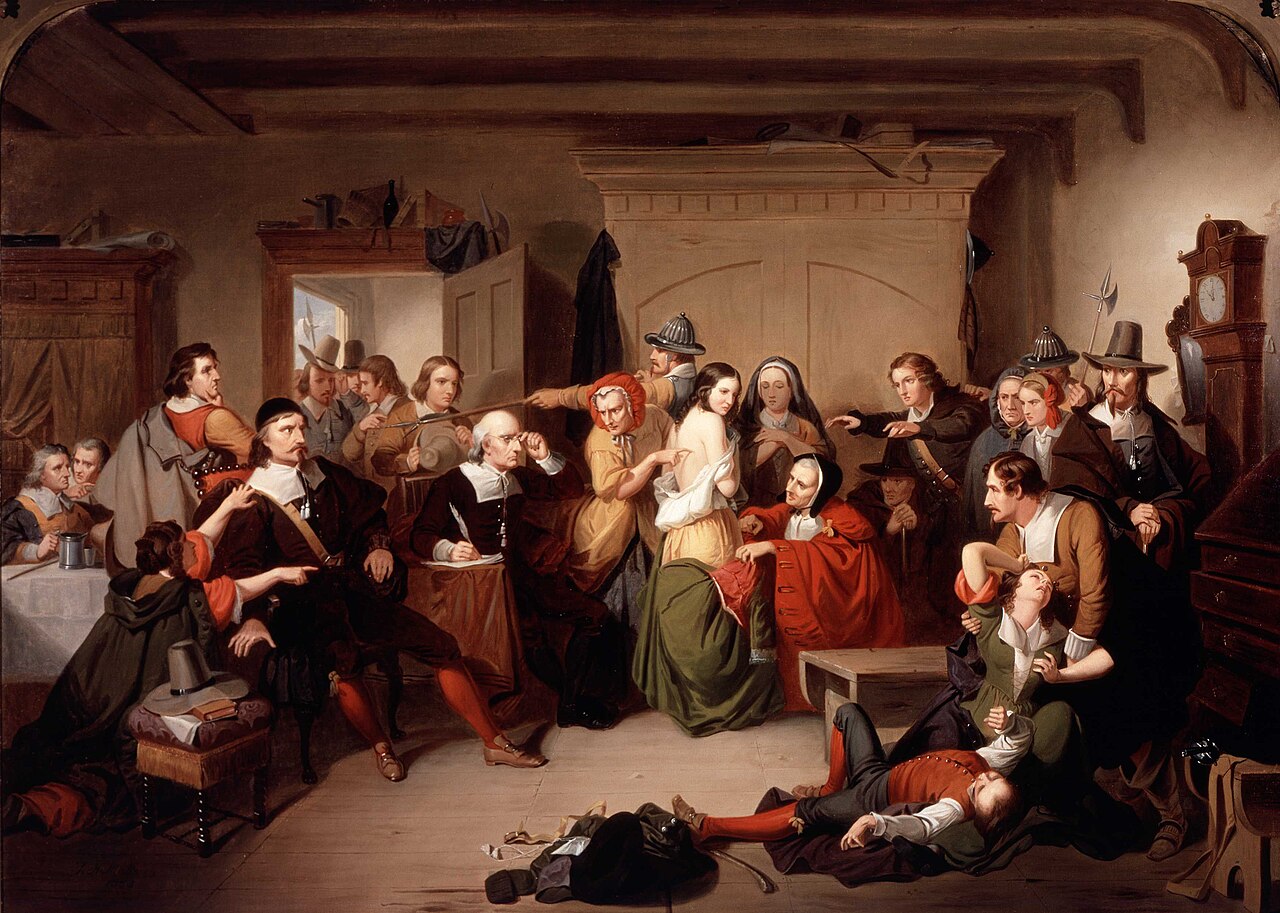
Examination of a Witch, painted by T. H. Matteson in 1853. It is an imagined scene, not any of the sisters.
The family
William Towne came from Great Yarmouth in Norfolk, where his children were christened at St Nicholas’ church in the 1620s and 1630s. He was at Salem by 1640, and later bought land at Topsfield, a few miles inland, where most of the family settled. He died without a will about 1672. In June 1673 the court put his estate in the hands of his widow, Johanna (Blessing) Towne, and there it stayed for ten years.
After Johanna’s death the children asked the court at Ipswich to divide it. Their petition, dated 17 January 1682/3, is copied into a volume of Ipswich deeds and wills, and it is the one record that names them all as brothers and sisters. It says the estate was “left to us by our Honored father deceased about tenn yeares agoe, who dyed & left no will”, and asks that the land go equally to “his three sons Edmond Jacob and Joseph” and the household goods to “the Daughters Rebecka, Mary & Sarah”. Edmund had already died, so his widow signed for his share. Jacob signed his name. Everyone else made a mark: Joseph Towne; Francis Nurse, “with the consent of Rebecka”; “Mary Esty formerly Mary Towne”; and Sarah Bridges. All of them came into court at Ipswich on 10 April 1683 and said it was their agreement, and the court allowed it.
Nine years later three of the six people on that page were accused of witchcraft.
Rebecca
Rebecca NurseW, the eldest, was christened at Great Yarmouth on 21 February 1621. She married Francis Nurse, a maker of wooden trays and household ware, and they raised eight children on a large farm in Salem Village, the part of Salem that is now Danvers. The farmhouse still stands.
She was about seventy-one, and in poor health, when she was arrested in March 1692. At her trial in June the jury found her not guilty. The accusers broke into fits in the courtroom, the judges asked the jury to reconsider, and on its second deliberation it found her guilty. She was hanged on 19 July 1692. Family tradition holds that her sons recovered her body that night and buried it on the farm.
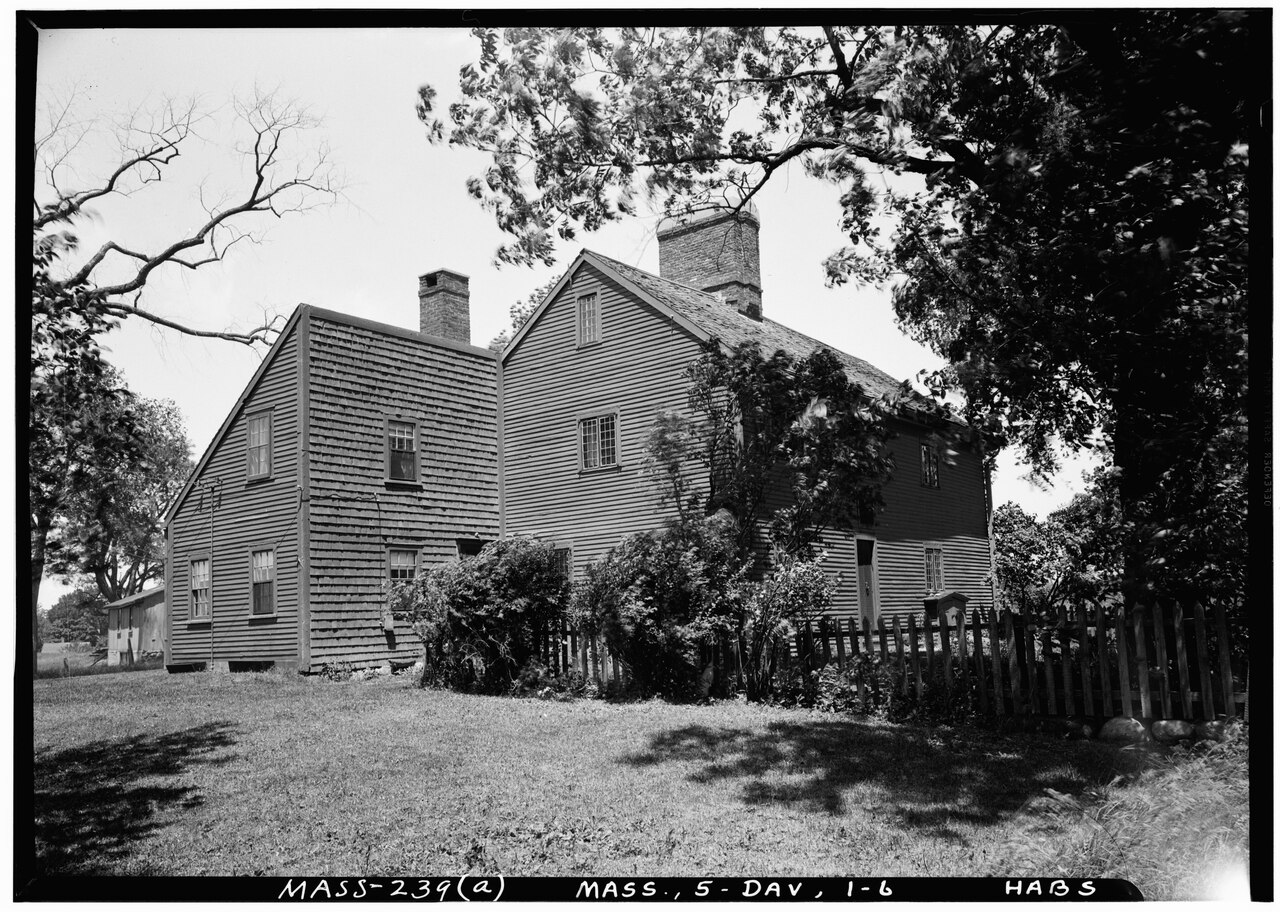
The Nurse house in Danvers, photographed for the Historic American Buildings Survey in 1940.
In 1885 her descendants put up a granite monument to her in the family burying ground on the farm, the first memorial to anyone accused of witchcraft in America. It carries lines written for it by the poet John Greenleaf WhittierW:
O Christian Martyr who for Truth could die
When all about thee owned the hideous lie!
The world redeemed from Superstition’s sway
Is breathing freer for thy sake today.
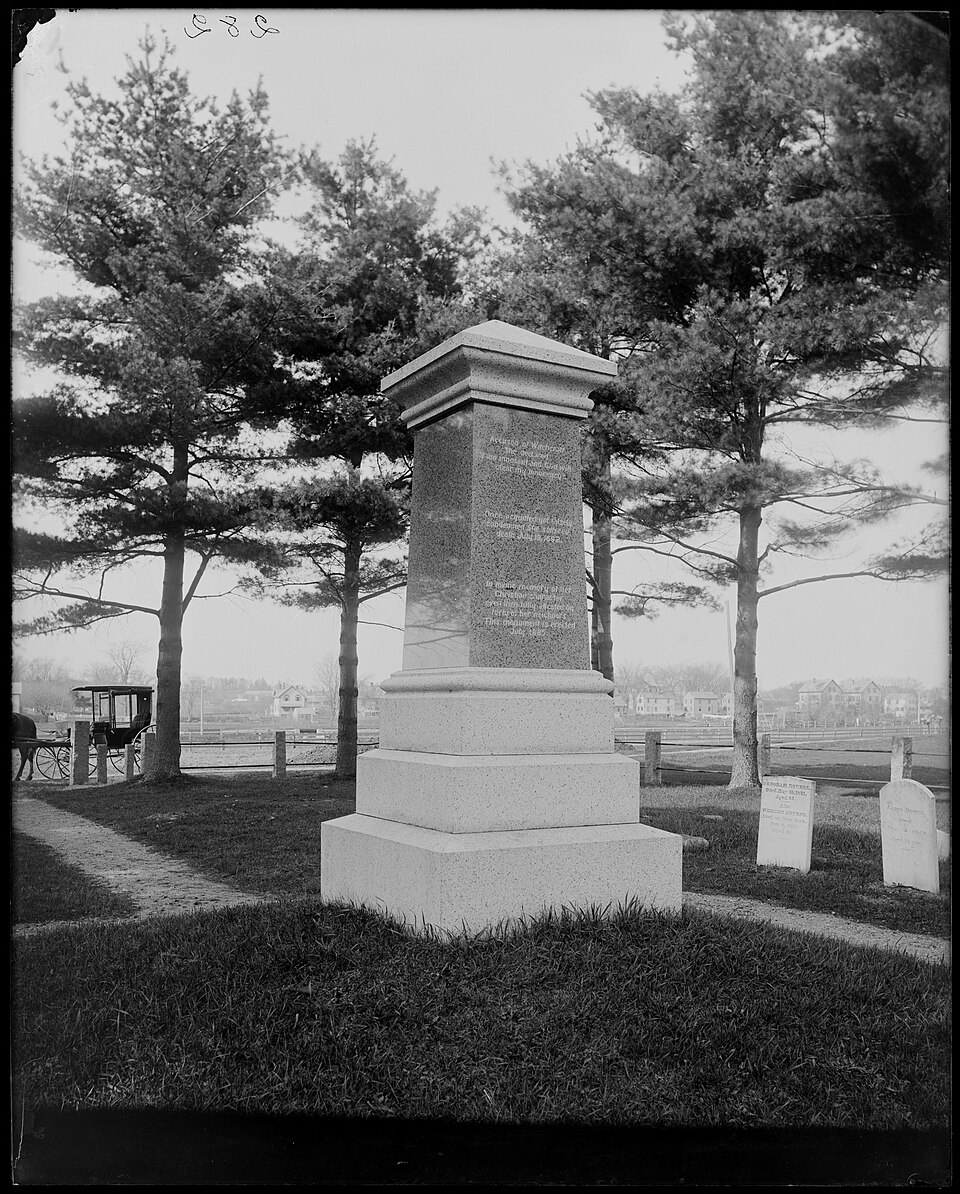
The Rebecca Nurse monument, photographed by Frank Cousins some time between 1885 and 1914.
Mary
Mary EstyW (the name is also written Easty, Estey and Eastey) was christened at Great Yarmouth on 24 August 1634. She married Isaac Esty of Topsfield, a cooper and farmer, and they had a large family there.
She was arrested in April 1692, and released in May. Two days later one of the accusers claimed to be tormented by her again, and she was taken from her bed that night and sent back to prison. While she waited to die she wrote to the judges, asking nothing for herself: “I petition your honours not for my own life for I know I must die”, but “that no more innocent blood be shed”. She was hanged on 22 September 1692 with seven others.
Sarah
Sarah CloyceW was the youngest of the three. She married first Edmund Bridges, in January 1659/60, and she was still Sarah Bridges when she signed the 1683 petition. By 1692 she was the wife of Peter Cloyes; a family history published in 1927 says she was his second wife.
Accounts of the trials tell that soon after Rebecca’s arrest, Sarah walked out of the Salem Village meeting house during the minister’s sermon, and the door shut hard behind her. Within days she was accused herself. She was examined in April and held for months, in Boston and then at Ipswich. In September a new accusation against her was made on behalf of a Rebecca Towne, her own niece and a daughter of her dead brother Edmund, whose widow had signed the petition beside her. Sarah was never tried. In January 1693 the grand jury of a new court returned all three indictments against her “Ignoramus”, refusing to send them to trial, the one for bewitching her niece among them. Accounts of the trials say that she and Peter then moved to Framingham; the 1927 family history has them at Sudbury, and says she died before 1704.
The family on both sides
The Townes were not all on one side. Edmund’s widow, Mary Towne, who had signed the 1683 petition with the three sisters, was summoned in September 1692 with four of her children as witnesses at Mary Esty’s trial. She wrote to the court that the family was too weak to come, and that her daughter Rebecca “hath Straing fits … espachaly If hur ant Easty be but named”. It was this Rebecca whom Sarah was charged with bewitching.
Jacob Towne’s part is less clear. On 30 December 1692 the Topsfield town meeting chose “Ens Jacob Towne” to serve on the grand jury at Salem, and that grand jury is the one that threw out Sarah’s indictments the following month. Whether he actually sat has not been found, and the ensign may have been his son Jacob rather than Jacob himself. No other record in the court papers names him.
In 1706 Ann Putnam, one of the chief accusers, stood before the Salem Village congregation and asked forgiveness, naming “Goodwife Nurse and her two sisters” in particular.
Ann was no relation, but her family and the Townes were old adversaries. George Francis Dow’s History of Topsfield describes years of lawsuits over the boundary between Topsfield and Salem Village, in which “the names of How, Towne, Estey, Baker, and Wildes frequently appear” on the Topsfield side, “while on the Salem side we have the Putnams”. In one suit of 1687, Isaac Esty, his son Isaac and three Townes testified that they had seen Captain John Putnam and his sons “cutting down tymber within Topisfield bounds”.
In popular culture
Rebecca Nurse is one of the central characters of Arthur Miller’s play The CrucibleW (1953), and Mary Esty is named in its last act as one of the condemned whose blameless lives the judges fear will turn the town against them. The 1985 television film Three Sovereigns for SarahW tells the story through Sarah Cloyce, played by Vanessa Redgrave, with Kim Hunter as Mary. Shirley MacLaine played Rebecca in the 2002 miniseries Salem Witch Trials. Earlier, Nathaniel Hawthorne gave the name “Goody Cloyse” to a respectable old woman revealed as a witch in his story “Young Goodman Brown”W (1835).
How the line comes down
Jacob Towne, the middle son, stayed at Topsfield and died there in 1704. His will, made three days before his death, names his daughter “Katharine ye Wife of Elisha Perkins”. From Katherine Towne and Elisha Perkins the line runs through their son Thomas Perkins, born at Topsfield in 1681, who moved to the Maine frontier at Cape Porpoise, later Arundel and now Kennebunkport; his son Thomas Perkins, town clerk of Arundel; his daughter Mary Perkins; her daughter Hannah Walker of Topsham; Hannah’s daughter Eliza Stone Wilson; Eliza’s daughter Frances E. Dennett; her daughter Anne Walker Merryman; and Anne’s son Kenneth Blanchard, Nancy Jane’s father.
How sure it is
Of the eleven steps from Nancy Jane back to William Towne, seven are now proved by a record that names the parent: her father’s obituary; her father’s birth record; her grandmother Anne’s marriage record of 1894, which names Anne’s parents; her great-grandmother Frances’s death certificate of 1925, which gives her mother’s maiden name as Eliza S. Wilson; a York County deed of 1744/5 between the two Thomas Perkinses, father and son; Jacob Towne’s will; and the 1683 petition.
Two things were caught on the way. There were three men called Thomas Perkins “Esquire” of Arundel, and a Topsfield Thomas Perkins who married Susanna Prescott in 1753 looks like the right man in the published genealogies but is not. And the petition was not where it was first looked for. Its date pointed to the Salem probate books, which were read page by page through 1682 and 1683 without finding it. It turned up in the Ipswich volume, because the court that allowed it sat at Ipswich.
What is still not proved:
- Three steps in the middle rest on printed town records and family histories, not on the original entries: that Eliza Stone Wilson was a daughter of Hannah Walker, that Hannah was a daughter of Mary Perkins, and that Mary was a daughter of the Arundel Thomas Perkins.
- That Ensign Thomas Perkins of Arundel is the Thomas born at Topsfield in 1681 to Elisha Perkins and Katherine Towne rests on the compiled Perkins genealogies. The Topsfield record of that birth exists; what no record yet says is that the two are one man.
- The family history that gives the children’s christening dates puts Sarah’s and Joseph’s christening at Salem on the same day in 1648. Sarah married in 1660, so she was probably born about 1641 and christened late.
- Two more children, John and Susanna, were christened at Great Yarmouth and are said to have died young. They are not in the 1683 petition and have not been entered in the tree.
- The Great Yarmouth register has not been read for the family; the christenings rest on a published family history and an index.
Updated 2026-09-29
People in this story
- ◉ William Towne –1673
- ○ Rebecca Towne –1692
- ○ Mary Towne –1692
- ○ Sarah Towne
- ◉ Jacob Towne –1704
- ◉ Katherine Towne 1662–1714
- ◉ Elisha Perkins 1656–1741
- ◉ Thomas Perkins 1681–1761
- ◉ Thomas Perkins –1794
- ◉ Mary Perkins 1758–1845
- ◉ Hannah Walker 1780–1867
- ◉ Eliza Stone Wilson 1812–1881
- ◉ Francis E. Dennett 1846–1925
- ◉ Anne Walker Merryman 1869–1942
- ◉ Kenneth Blanchard 1897–1975
- ◉ Nancy Jane Blanchard 1929–2006