A family story · Delahorne and Blanchard line · 2026-09-30
New Les Filles du Roi and the Carignan Regiment
Louis XIV sent a regiment to fight the Iroquois and over 700 young women to marry the colony's settlers. Six of those women and three of those soldiers are in the family tree, and twice one of the king's daughters married one of the king's soldiers.
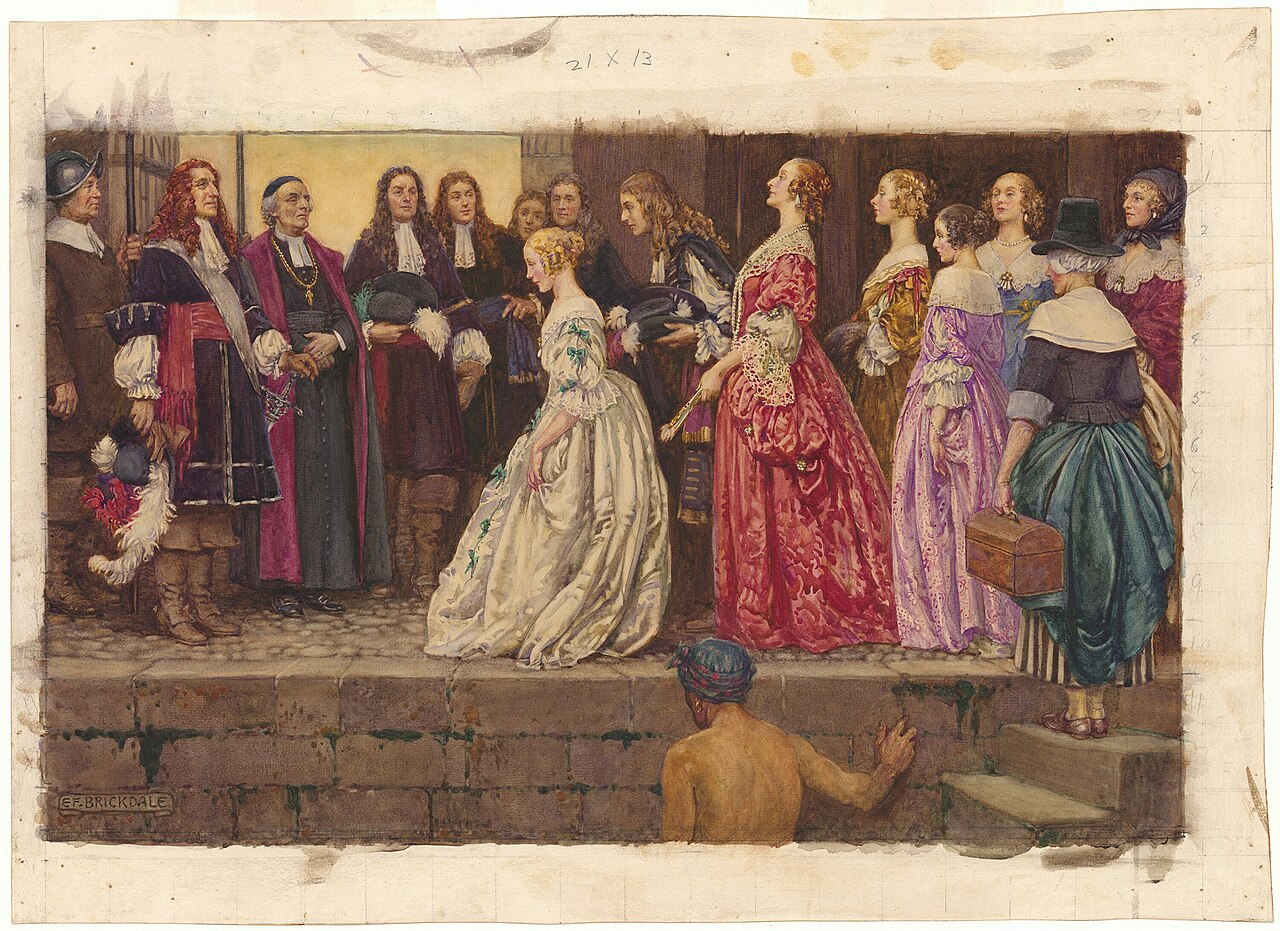
L’arrivée des Filles du Roi, painted by Eleanor Fortescue-Brickdale in 1927. It is an imagined scene: the intendant Jean Talon and Bishop Laval greet the women at Quebec.
Between 1663 and 1673 the French crown sent over 700 women to New France to marry its settlers, and in 1665 it sent the Carignan-Salières RegimentW to put an end to the Iroquois raids on the colony. Six women in the family tree are on both of the published lists of these women, the filles du roi or King’s DaughtersW, and three men in it served in the regiment. Five of the six women and all three soldiers are direct ancestors, on two branches: the line of Floyd Amatus Delahorne (1922–2014) and the line of Nancy Jane Blanchard (1929–2006). In two of the couples, a woman of the king’s sending married a soldier of the regiment.
The regiment and the women
The colony had long had trouble keeping its people. Men brought out under contract to work for a set term mostly went home when the term ended, put off by the winters, the Iroquois raids and the shortage of women to marry. On 19 June 1665 the ship Joyeux Simeon docked at Quebec, sixty-one days out of La Rochelle, with the advance party of the Carignan-Salières Regiment, the first regiment of French regular troops to serve in Canada. It had twenty companies, each named after its captain except the colonel’s own, and with the four companies that came from the West Indies with the Sieur de Tracy it came to more than twelve hundred men.
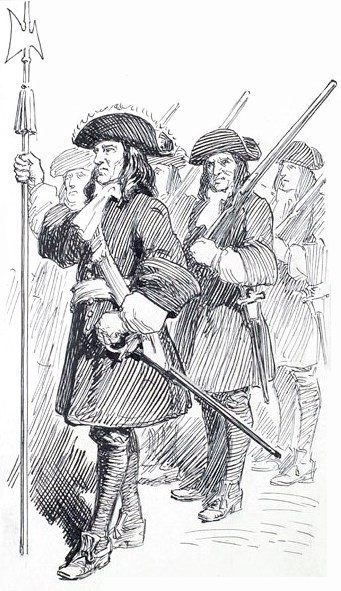
Officer and men of the Carignan-Salières Regiment, drawn by C. W. Jefferys long after the event.
After peace treaties with the five nations of the Iroquois (Mohawk, Oneida, Onondaga, Cayuga and Seneca) had been signed, the regiment was sent home in 1668. The king had planned for that before it sailed: his instructions to the intendant Jean TalonW told him to invite the soldiers to stay, with a small gift of money to help them settle. Of the twelve to thirteen hundred officers and men, 446 are known to have settled in Canada, among them 404 private soldiers, and about a hundred more stayed on in the army there.
The women came over the same eleven years. No official list of those who sailed or landed was kept, so every count is a reconstruction from the parish registers and notaries’ records. Yves Landry, whose study of 1992 is the standard work, counted 770; earlier compilers had reached 713, 774 and 792. An older definition that Landry quotes has them crossing at the king’s expense and receiving on marriage “le présent du roi de 50 livres aux roturières et de 100 livres aux demoiselles”, 50 livres for a commoner and 100 for a woman of gentle birth. Landry found that the picture of Parisian orphans from the Hôpital général of Paris fits mainly the contingents of 1669, 1670 and 1671, nearly half of the whole; across all eleven years more than half came from outside the Paris region, almost a third were country-born, and only one in four could write her own name. Women who arrived in years other than 1669 to 1671 did not, with rare exceptions, receive the king’s gift.
The two lists
Two published lists are used here. PRDH, the population register of early Québec, keeps a list of the Filles du Roi, 711 women who came between 1663 and 1673 with royal aid and settled by marriage. La Société des Filles du roi et soldats du Carignan, Corp. (SFRSC), a lineage society for their descendants, keeps a list of about 740 women, and a second list of the regiment’s officers and soldiers who married one of them. All six women below appear on both lists.
Anne Girard
Anne Girard came from Saint-Cyr-du-Vaudreuil in Normandy, the daughter of Michel Girard and Françoise de Graffard, and arrived in 1665. She married Nicolas Daudelin at Château-Richer on 22 October 1665, the day after their marriage contract was drawn up; neither could sign. On PRDH’s list she is no. 17379. She died at Varennes on 22 August 1710. She was the ninth great-grandmother of Nancy Jane Blanchard, through her daughter Anne Daudelin (born 1667).
Marie Benoit and Pierre Favreau
Marie Benoit is no. 28732 on PRDH’s list, as Marie-Madeleine Benoit. Landry records her as of unknown origin, born about 1653, and arrived in 1667, so she was about fourteen. He gives her marriage as before 1668, at Contrecoeur, to Pierre Favreau dit Deslauriers, “soldat de la compagnie de Contrecoeur au régiment de Carignan”; the regiment’s roll lists Pierre Favreau (Des Lauriers) in that company, and PRDH places the marriage by the end of 1668 (its date of 31 December 1668 stands for “by 1668”, not for a recorded day). The couple settled first around Contrecoeur and Sorel and later farmed the land of the seigneur Pierre Boucher at Boucherville. Landry credits them with thirteen children. Pierre died on 26 May 1708 and Marie at Montréal on 18 June 1725. They were the ninth great-grandparents of Nancy Jane Blanchard, through their daughter Marie Anne Favreau dit Deslauriers.
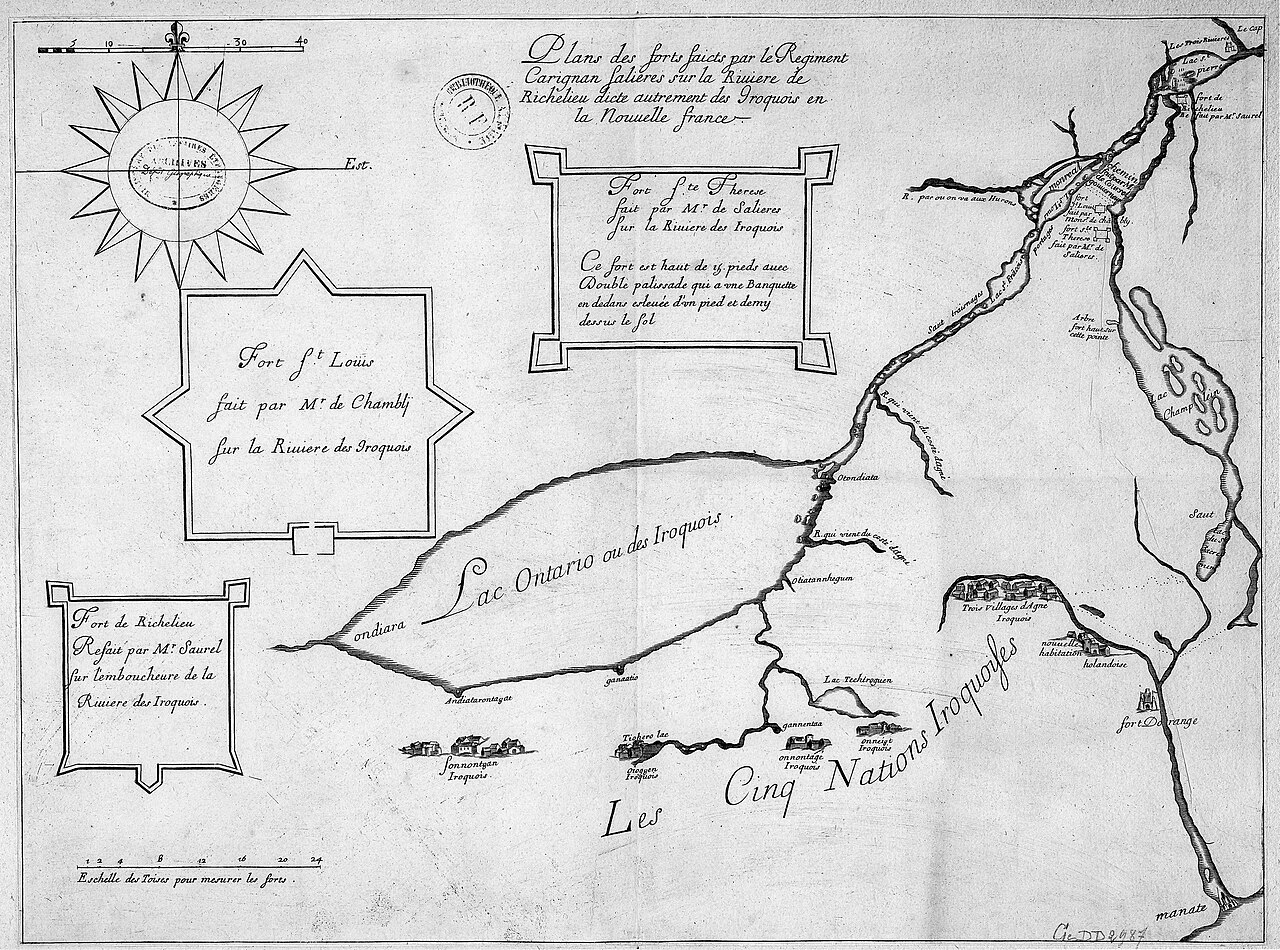
Plan of the forts the regiment built on the Richelieu, “otherwise called the river of the Iroquois”, from an eighteenth-century copy. Fort Richelieu, at the river’s mouth, is where Sorel stands today.
Marie Devault and Antoine Emery dit Coderre
Marie Devault came from Nogent-le-Roi, in the Beauce, and arrived in 1667, bringing goods valued at 200 livres. She married Antoine Emery dit Coderre, who appears on the regiment’s roll as “Antoine Emery, Sieur de Coderre”, in the same company of Contrecoeur as Pierre Favreau. The date of the marriage is not settled. Landry gives it as 1667 or 1668, with a marriage contract dated 13 April 1674; PRDH’s list, where she is no. 24397, gives 1669; and the Société’s list of soldiers gives 13 April 1674, the date of the contract. The couple lived at Contrecoeur and had eleven children, and Marie is said to have been buried on 6 December 1687, a date that comes from compiled sources; the burial act itself has not been read.
Marie Devault is not herself an ancestor. By a contract of 5 June 1688 Antoine married, as his second wife, Marie Anne Favreau dit Deslauriers, the daughter of Pierre Favreau and Marie Benoit. In January 1700 her brother Mathurin Favreau married Madeleine Emery, a daughter of Antoine and Marie Devault, so the two soldier-and-fille-du-roi households were joined by two marriages. Antoine was the eighth great-grandfather of Nancy Jane Blanchard, through Francois Emery dit Codere (1700–1755), a son of the second marriage.
Madeleine Chrétien
Madeleine Chrétien was a Parisian, the daughter of Toussaint Chrestien and Françoise Bertault of the parish of Saint-Eustache, and arrived in 1670. She married Pierre Chicoine, a settler of Longueuil who had come out in 1663 as a hired man, at Montréal on 20 October 1670. On PRDH’s list she is no. 13452. Landry records that she could sign her name, which set her apart from most of the women. After Pierre’s death she married Louis Pierrecot de Bayeul at Contrecoeur in 1702, and she was buried there on 25 February 1709. She was the ninth great-grandmother of Nancy Jane Blanchard, through her daughter Madeleine Chicoine (1672–1745).
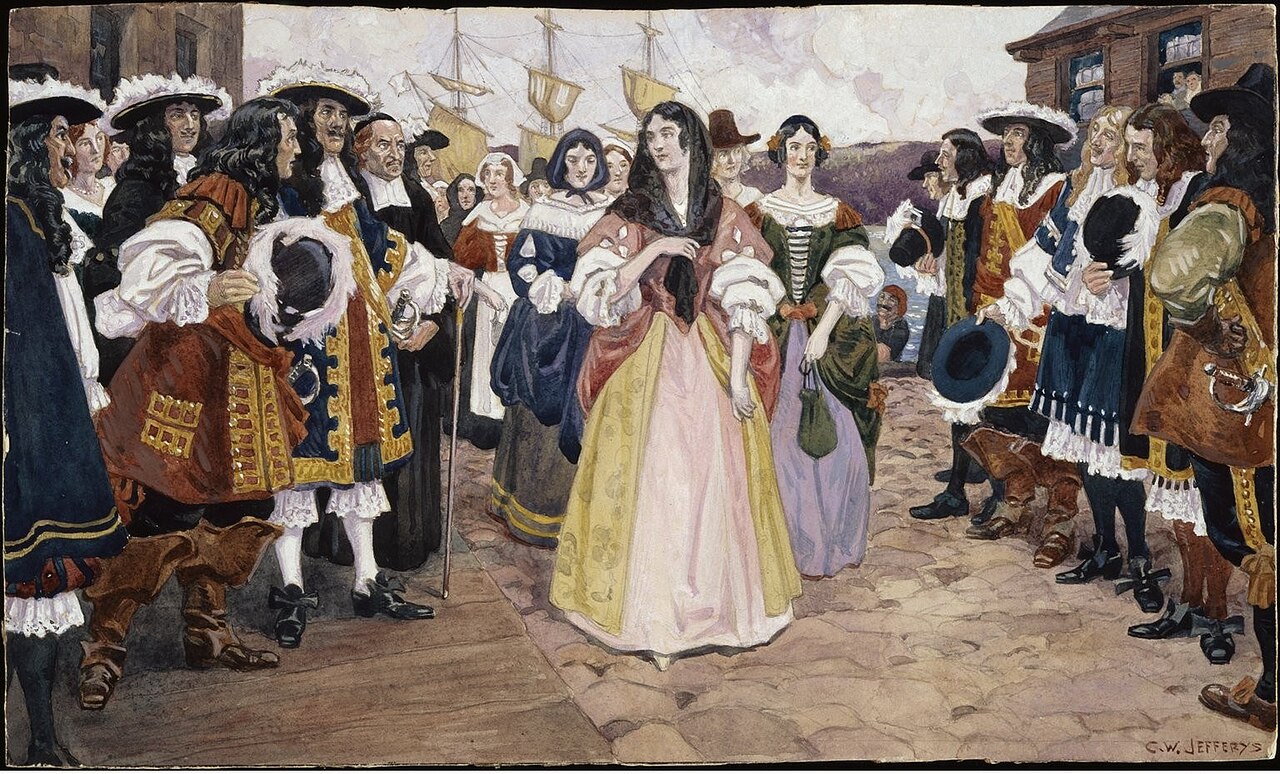
The Arrival of the French Girls at Quebec, 1667, painted by C. W. Jefferys. It is an imagined scene; Madeleine Chrétien and Anne Masson both came three years later, in 1670.
Anne Masson
Anne Masson came from Moitiers-d’Allonne, in the diocese of Coutances in Normandy, the daughter of Nicolas Masson and Martine-Bertine Duval. She arrived in 1670, and Landry’s entry for her reads: “apportant des biens estimés à 200 livres et un don du roi de 50 livres”, bringing goods valued at 200 livres and a gift from the king of 50. She married Robert Gallien of Beauport at Québec on 8 September 1670; on PRDH’s list she is no. 30529. She was buried at Québec on 13 September 1710. She was the eighth great-grandmother of Floyd Amatus Delahorne, through her son Pierre Galien (born 1683).
Marie Briau: a case in doubt
Marie Briau, also written Briault and Priault, married Pierre Joffrion about 1669, and the couple settled at Verchères. She is on PRDH’s list as no. 35634, and the Société’s list gives the marriage as 1668 or 1669. Landry’s catalogue has an entry for her, of unknown origin and arrived in 1668. But no record of her marriage and no marriage contract survives, and in the introduction to the same study Landry names her among women whose coming to Canada as single women or widows the lack of either document makes “tout aussi hypothétique”, just as hypothetical. She may have been a fille du roi, or she may have arrived already married. She was the sixth great-grandmother of Floyd Amatus Delahorne, through her son Jean Joffrion (born 1671).
Guillaume Richard dit Lafleur
Guillaume Richard, called Lafleur, is the third soldier of the regiment in the tree. He sailed with the regiment in 1665 and chose to stay when it went home. The regiment’s historian Jack Verney writes that he “settled in Canada in 1668 and became the first commandant of Fort FrontenacW in 1673”, and that he “was killed in a skirmish with a band of Iroquois in 1690”. His wife, Agnes Tessier, whom he married at Montréal in 1675, was not one of the King’s Daughters, so he is not on the Société’s list of soldiers. He was the ninth great-grandfather of Nancy Jane Blanchard, through his son Jean Baptiste Richard dit Lafleur (1682–1730).
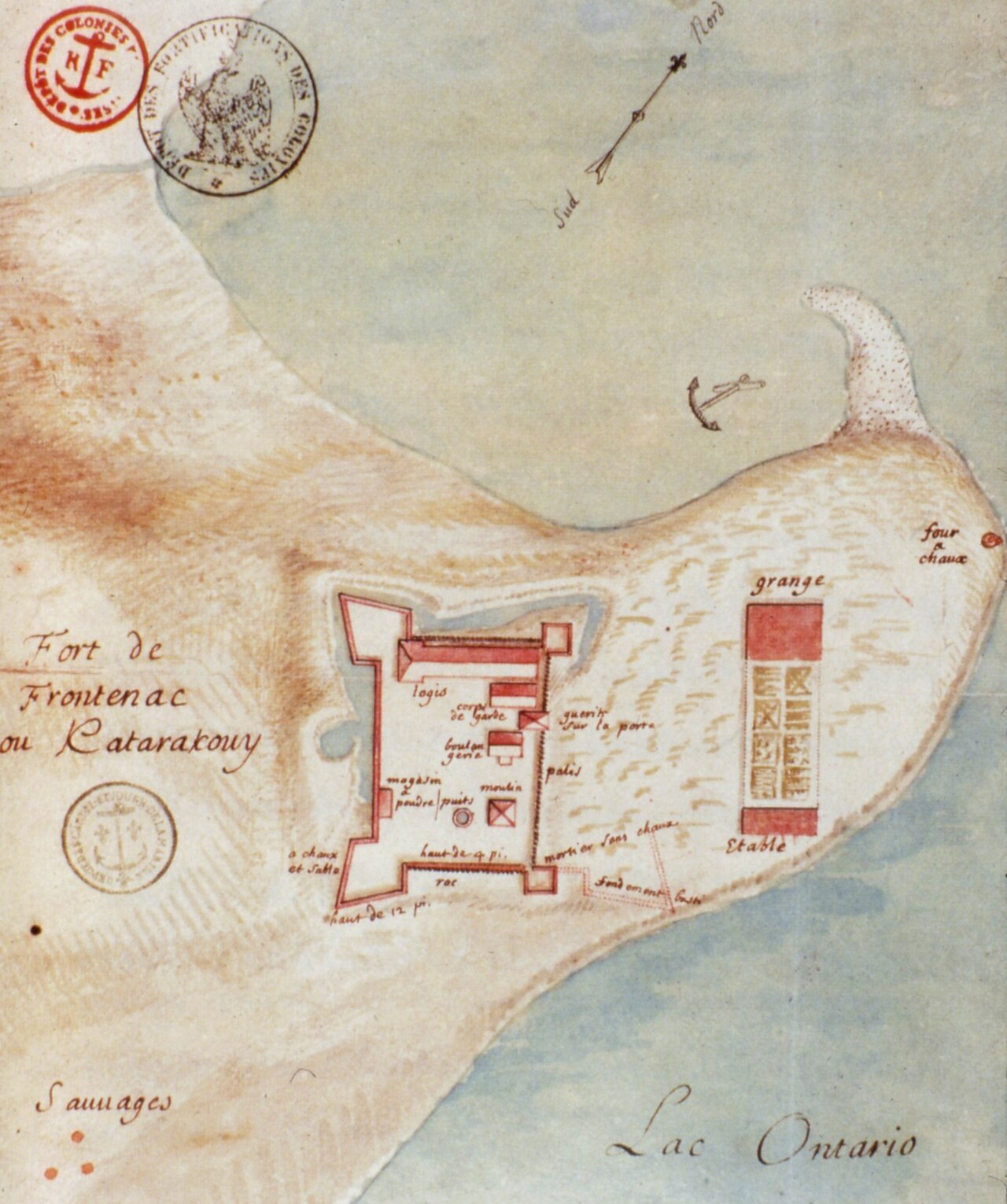
Fort Frontenac at Cataraqui, now Kingston, Ontario, in a plan of 1685 kept in the French colonial archives.
Lafleur’s fort has seen better days. Its site at Place d’Armes is now overlooked by Slush Puppie PlaceW, an ice hockey and curling arena, named after a frozen beverage.
The husbands of the other four women, Nicolas Daudelin, Robert Gallien, Pierre Chicoine and Pierre Joffrion, are not on the Société’s list of soldiers or in the part of the regiment’s roll checked against the tree.
What is still open
- Whether Marie Briau came to Canada single, as a fille du roi, or already married.
- The year Marie Devault married Antoine Emery: 1667 or 1668, or 1669.
- Where Marie Benoit came from, and who her parents were.
- Whether any other man in the tree served in the regiment: its surviving roll names only about a third of the men, and only part of that roll has been checked against the tree.
Sources
- The women: PRDH, "Les Filles du Roi" (prdh-igd.com), with the numbers quoted above; La Société des Filles du roi et soldats du Carignan, Corp. (SFRSC), "A Listing of the Filles du roi (King's Daughters)" and its listing of the regiment's officers and soldiers who married Filles du roi (fillesduroi.org); Yves Landry, Les Filles du roi au XVIIe siècle: Orphelines en France, pionnières au Canada (1992), catalogue entries pp. 277, 291, 306–307, 318, 346 and 360, and p. 40 note 72 for the doubt over Marie Briau; the family's parish and notarial records as given on each person's page.
- The soldiers: Jack Verney, The Good Regiment: The Carignan-Salières Regiment in Canada, 1665–1668 (1991), the nominal roll in Appendix B, pp. 153–154 (the Contrecoeur company) and p. 171 (Guillaume Richard).
- Background: Verney, pp. 4, 7, 18, 108, 110, 145 and 190, for the regiment's purpose, arrival, size and the numbers who stayed; Landry, pp. 22, 35, 40, 106 and 107, for the count of the women, the king's gift and where they came from.
Background from these two histories is not something the family's own records establish.
People in this story
- ◉ Anne Girard –1710
- ◉ Nicolas Daudelin –1699
- ◉ Marie Benoit 1653–1725
- ◉ Pierre Favreau 1636–1708
- Marie Devault 1647–1687
- ◉ Antoine Emery dit Coderre –1715
- ◉ Madeleine Chrétien 1652–1709
- ◉ Pierre Chicoine –1692
- ◉ Anne Masson 1637–1710
- ◉ Robert Gallien 1636–1711
- ◉ Marie Briau 1649–1699
- ◉ Pierre Joffrion 1638–1704
- ◉ Guillaume Richard 1641–1690