Howland · ◉ direct ancestor
♂John Howland
Born before 1593. Died 1673, Plymouth, Plymouth Colony, British Colonial America.
John Howland (died February 1672/73) was a Mayflower passenger from Fenstanton in Huntingdonshire who crossed in 1620 as a servant in the household of John CarverW, and rose to be an Assistant and a long-serving Deputy of Plymouth Colony. During the crossing he was washed overboard in a storm and survived by catching hold of a rope trailing from the ship. He was the ninth great-grandfather of Frederic Roger Curtis (1928–2007), through his daughter Desire Howland (1625–1683).
Early life
Elizabeth Pearson White’s volume on him in the Mayflower Families series states that he was reared at Fenstanton, a town nine miles northwest of Cambridge, the son of Henry Howland, a yeoman who died there on 17 May 1635, and his wife Margaret, who was buried there on 31 July 1629. No baptism has been found for him. White bases the identification on the probate records of his brother Humphrey Howland, a London draper, whose will of 1646 names his brothers Arthur, John and Henry and a sister Margaret, the wife of a Fenstanton shoemaker. Two of those brothers, Henry and Arthur, later followed John to Plymouth Colony, so that three separate Howland families were settled there within twenty years. When he died he was said to be above eighty, and a compiled genealogy places his birth before 1593. Caleb Johnson and R. C. Anderson prefer about 1598, from his place as a younger son of Henry Howland of Fenstanton, his servant’s status in 1620 and his marriage about 1623.
The Mayflower
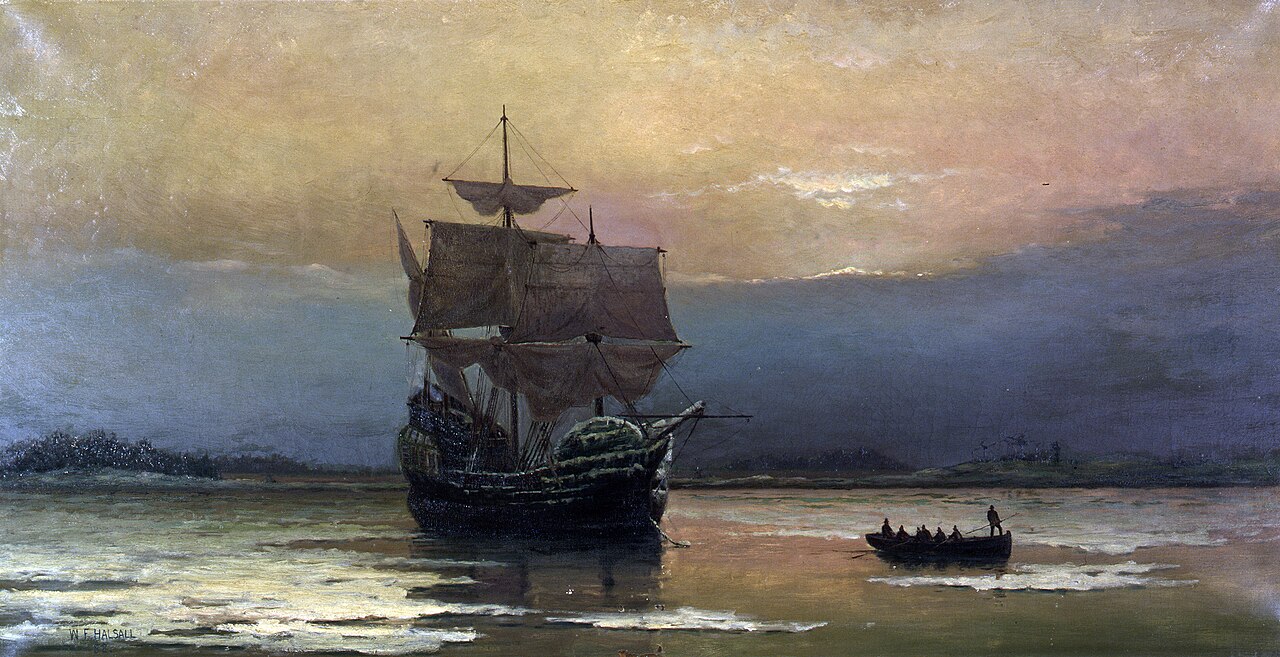
He left home before 1620 and went to London, where he was taken into the household of John Carver, soon to be the first governor of the colony, as a servant. At Cape Cod on 11 November 1620 he signed the Mayflower Compact. Governor William BradfordW called him “a lusty younge man”, and records what happened to him on the voyage. In a storm, with the sails taken in, he came up on deck and was thrown into the sea, but “it pleased God that he caught hould of ye halliards which hunge over board, and rane out at length; yet he was held up … and then with a boat hooke and other means got into ye ship again.”
The Carvers came through the first winter, but in April 1621 the governor came in from his field ill and “never spake more”, and his wife died soon after. They had no children, and John Howland is thought to have taken over what was left of their household. In the division of land of 1623 he was given four acres as head of a household. White reports two accounts of the shares. One researcher counts one share for John Howland himself and three for Elizabeth TilleyW and her parents, John and Joan Tilley, who had died in the first winter. Franklyn Howland’s family history instead has the household at four people: John Howland with Desire Minter, a girl who had crossed with the Carvers; a boy, William Latham; and Elizabeth Tilley. White goes on to reckon four shares on that second count.
Marriage and family
He married Elizabeth Tilley at Plymouth, on or about 25 March 1623 in White’s account, the first day of the year in the reckoning then used. She had been baptized at Henlow in Bedfordshire on 30 August 1607, and so was not yet sixteen. White, citing Bradford’s record of the division of the colony’s cattle on 1 June 1627, has the couple listed with two children, Desire and John. They had ten in all, born between about 1625 and 1649: six daughters and four sons. White writes that they named their eldest, Desire, after Desire Minter, who had gone back to England and died there.
Kennebec and colony office
In 1626 Bradford, Isaac AllertonW and Myles Standish took him in as one of the “undertakers” who were granted the colony’s trade in return for taking on its debt to the London merchants who had backed the voyage. He was put in charge of the colony’s trading post on the Kennebec River, in what is now Maine, where furs were bought from the Native people, and White suggests that some of his children may have been born there. In 1634 a rival trader, John HockingW, anchored above the post to cut off its trade and refused to leave. Howland sent three men in a canoe to cut his cables; when Hocking levelled a gun at one of them, Moses Talbot, Howland, in the words of the colony’s report, called to him “desiring him not to shut his man but take himselfe for his mark”. Hocking shot Talbot dead and was himself killed by a shot from the Plymouth boat. The killing led to John Alden’s arrest in Boston, and the court there later found Hocking at fault.
He was chosen an Assistant, one of the governor’s council, on 3 March 1634/35. Over the next thirty-five years he represented Plymouth or Duxbury at the General Court many times, and was a Deputy in 1652, 1659 and every year from 1661 to 1668, and again in 1670. He also served as an assessor, a surveyor of highways and a selectman. On 2 February 1638/39 he paid John Jenny £82 for a house and land at Rocky Nook, then part of Plymouth and now in Kingston, and he lived there for the rest of his life. In 1639 he took up land at Yarmouth on Cape Cod, where his daughters Desire and Hope settled, and he later gave his son John a farm at Barnstable.
Death
He died at Rocky Nook, on 23 February 1672/73 according to White and later compilers, and was buried at Plymouth on 25 February 1672/73. Nathaniel Morton, the colony’s secretary, wrote that he “lived untill hee attained above eighty yeares in the world hee was one of the first Comers into this land and proved a usefull Instrument of Good in his place & was the last man that was left of those that Came over in the shipp Called the May Flower that lived in Plymouth hee was with honor Intered att the Towne of Plymouth on the 25 February 1672”. The minister John Cotton called him “a good old disciple & had bin sometime a magistrate here, a plaine-hearted christian”. A compilation of Mayflower families places his grave on Burial HillW.
His will, dated 29 May 1672 and proved on 5 March 1672/73, divided his lands among his sons John, Jabez, Isaac and Joseph, the last to have the Rocky Nook house after his mother’s death, and left twenty shillings to each of his married daughters, “Desire Gorham, Hope Chipman, Elizabeth Dickinson, Lydia Browne, Hannah Bosworth and Ruth Cushman”, and the rest of his estate to his “Deare and loveing wife Elizabeth howland”. His personal estate was valued at £157 8s 8d; among it were “one great Bible and Annotations on the five books of Moses” and the works of Tyndale and Wilson. Elizabeth outlived him by nearly fifteen years and died at Swansea, at the home of their daughter Lydia, on 21 December 1687.
Notes
The date of his marriage is not settled. White gives on or about 25 March 1623 without stating her grounds; Susan E. Roser’s Mayflower Increasings (1995), citing the Mayflower Descendant, puts it about 1624–25.
Morton’s words make him the last man of the Mayflower company living at Plymouth. He was not the last passenger: Mary AllertonW, who had crossed as a small girl, lived at Plymouth until 1699.
Family time line
Stories
Recorded events
| Event | When | Where | Evidence ?on record - the record itself, its image, or a transcript or printed copy of it has been read from a compiled source - an index, a printed genealogy or a memorial page says so not yet documented - in the family record, no source attached yet |
|---|---|---|---|
| Birth above eighty at his death in Feb 1672/3 (PCR 8:34) |
bef 1593 | from a compiled source | |
| Living at reared at Fenstanton, son of Henry and Margaret Howland; left home before 1620 |
1620 | Fenstanton, Huntingdonshire, England | from a compiled source |
| Living at Plymouth Division of Cattle, 1 June 1627 (new style): John and Elizabeth Howland with Desire and John Jr. |
1627 | Plymouth, Plymouth Colony, British Colonial America | from a compiled source |
| Death | 23 Feb 1673 | Plymouth, Plymouth Colony, British Colonial America | on record |
| Burial 25 February 1672/3 |
25 Feb 1673 | Plymouth, Plymouth Colony, British Colonial America | from a compiled source |
Sources
- Mayflower Increasings, Susan E Roser — Birth, Death, Burial
- Anderson, Robert Charles. The Great Migration Begins: Immigrants to New England 1620-1633, vol. 2 (Boston: NEHGS, 1995) - JOHN HOWLAND (Sources shelf gmb2) — Birth, Death
- White, Elizabeth Pearson, 'John Howland of the Mayflower: the first five generations' (Camden, Me.: Picton Press, 1990-), the Mayflower Families series — Living at, Death, about this person, Marriage (Elizabeth Tilley)
- The Mayflower Descendant, vol. 2 (1900), pp.70-77 - John Howland's Will and Inventory (Plymouth Colony Wills III:1:49-54) — Death, about this person
- The Mayflower Descendant, vol. 2 (1900), pp. 70-77, 'John Howland's Will and Inventory' (G. E. Bowman): transcript of Plymouth Colony Wills and Inventories vol. 3 pt. 1 pp. 49-54 — Death
- Records of the Colony of New Plymouth in New England, vol. 12, Deeds &c. 1620-1651 (Pulsifer, 1861), the Division of Cattle, 22 May 1627 — Marriage (Elizabeth Tilley)
Borders as they stood about 1600 (they follow the event under the mouse), from the historical-basemaps project, the Newberry Library's Atlas of Historical County Boundaries (states and territories, 1783 on) and Natural Earth; the colonies and provinces are drawn along today's lines.
Line of descent
- Henry Howland –1635
- Margaret (surname unknown) –1629
Descendants
- Desire Howland 1625–1683
- Desire Gorham 1644–1700
- Elizabeth Hawes 1662–
- Mary Hawes 1664–
- Edmond Hawes 1669–
- John Hawes 1671–
- Joseph Hawes 1673–
- Jabez Hawes 1675–
- Ebenezer Hawes 1679–
- Ebenezer Hawes 1705–
- Isaac Hawes 1681–
- Sarah Hawes 1719–1788
- Desire Hawes 1682–
- Jabez Hatch 1709–1763
- Benjamin Hawes 1683–bef 1722
- Experience Hawes 1706–
- Jedidah Hawes 1709–1764
- Benjamin Hawes 1712–
- Samuel Hawes 1717–
- Shubael Hawes 1720–1722
- Shubael Hawes 1722–
- Experience Hawes
- Mary Sprout 1715–1777
- Ebenezer Sprout 1717–1786
- Temperance Gorham 1646–
- Desire Sturgis 1667–1749
- Temperance Dimmock 1689–1773
- Fear Sturgis 1678–1753
- Mary Holmes 1712–1759
- Desire Sturgis 1667–1749
- Elizabeth Gorham 1648–bef 1684
- Lois Hallett 1672–1726
- Gideon Cobb 1691–1759
- Elizabeth Hallett 1679–1759
- James Cobb 1698–1749
- Stephen Cobb 1714–1754
- Lois Hallett 1672–1726
- James Gorham 1650–
- James Jr Gorham 1676–1718
- Isaac Gorham 1715–
- Experience Gorham 1678–1733
- Lydia Lothrop 1716–
- Mehitable Lothrop 1717–1764
- James Jr Gorham 1676–1718
- John Gorham 1651–
- Stephen Gorham 1683–1743
- Susanna Gorham 1705–1777
- Nathaniel Gorham 1709–1761
- Shubael Gorham 1686–1746
- Joseph Gorham 1725–1790
- Stephen Gorham 1683–1743
- Joseph Gorham 1653–
- Sarah Gorham 1678–1705
- Elizabeth Howes 1701–1791
- Sarah Gorham 1678–1705
- Jabez Gorham 1656–
- Isaac Gorham 1689–1740
- Timothy Gorham 1723–1768
- Isaac Gorham 1689–1740
- Mercy Gorham 1658–
- Joseph Denison 1681–1725
- Nathan Denison 1715–1803
- Joanna Denison 1717–1778
- Samuel Denison 1686–1724
- Sarah Denison 1710–1794
- Gideon Denison 1723–1795
- Elizabeth Denison 1689–1749
- Christopher Champlin 1707–1776
- Desire Denison 1693–1737
- Thankful Williams 1718–1767
- Mercy Williams 1719–
- Joseph Denison 1681–1725
- Lydia Gorham 1661–
- Desire Thatcher 1688–1722
- Josiah Crocker 1719–1774
- Hannah Thatcher 1690–1780
- Lydia Otis 1716–1807
- John Otis 1728–1804
- Desire Thatcher 1688–1722
- Hannah Gorham 1663–
- Mary Whelden –1734
- Rhoda Crowell 1705–1760
- Mary Whelden –1734
- Shubael Gorham 1667–
- Desire Gorham 1644–1700
- John Howland 1627–aft 1699
- Hannah Howland 1661–1711
- Hannah Crocker 1688–1751
- Hannah Fuller 1718–1753
- Hannah Crocker 1688–1751
- Hannah Howland 1661–1711
- Hope Howland 1629–1683
- Elizabeth Chipman 1647–1712
- Lydia Joyce 1684–1755
- Prince Howes 1718–1799
- Lydia Joyce 1684–1755
- Lydia Chipman 1654–1730
- Lydia Sargent 1682–1780
- Hannah Waite 1709–1789
- Lydia Sargent 1682–1780
- John Samuel Chipman 1670–1756
- Lydia Chipman 1708–1790
- Alice Swift 1731–1783
- Lydia Chipman 1708–1790
- Elizabeth Chipman 1647–1712
- Elizabeth Howland 1631–1691
- James Dickinson 1675–1741
- James Dickinson 1700–1774
- Amos Dickinson 1704–1793
- Tertullus Dickinson 1745–1824
- James Dickinson 1675–1741
- Lydia Howland 1633–1710
- James Brown 1655–1718
- Dorothy Brown 1694–1738
- Benjamin Medbury 1727–1796
- Mercy Brown 1699–
- Rebeckah Carpenter 1728–1800
- Dorothy Brown 1694–1738
- James Brown 1655–1718
- Hannah Howland 1637–1708
- David Bosworth 1669–1747
- Hannah Bosworth 1705–1757
- Samuel Ripley 1747–1826
- Hannah Bosworth 1705–1757
- John Bosworth 1671–1719
- Elizabeth Bosworth 1703–1725
- John Thomas 1721–1793
- Elizabeth Bosworth 1703–1725
- Jabez Bosworth 1673–1747
- Zachariah Bosworth 1701–1726
- Susannah Bosworth 1726–1769
- Zachariah Bosworth 1701–1726
- David Bosworth 1669–1747
- Joseph Howland 1640–1703
- Thomas Howland 1665–1739
- Joanna Howland 1716–1810
- Gideon White 1753–1833
- Joanna Howland 1716–1810
- Lydia Howland 1674–1733
- Prudence Jenkins 1710–1793
- Joseph Baker 1748–1804
- Prudence Jenkins 1710–1793
- Thomas Howland 1665–1739
- Jabez Howland 1644–1712
- Jabez Howland 1669–1732
- Patience Howland 1716–1802
- Williams Barker 1744–1806
- Patience Howland 1716–1802
- Jabez Howland 1669–1732
- Ruth Howland 1646–
- Robert Cushman 1664–1757
- Robert Cushman 1698–1751
- Thomas Cushman 1670–1726
- Thomas R Cushman 1705–1768
- Sarah Ann Cushman 1743–1827
- Zibiah Cushman 1708–1743
- Sarah Cooke 1729–1806
- Thomas R Cushman 1705–1768
- Robert Cushman 1664–1757
- Isaac Howland 1649–1723