Brewster · ◉ direct ancestor
♂William Brewster
Born about 1566, Scrooby, Bassetlaw District, Nottinghamshire, England. Died 1644, Duxbury, Plymouth Colony, British Colonial America.
William Brewster (about 1566 – 10 April 1644) was a postmaster of Scrooby in Nottinghamshire who became the ruling Elder of the separatist congregation known as the Pilgrims, sailed with it on the Mayflower in 1620, and served as the Elder of the church at Plymouth for the rest of his life. When he died, his books were appraised at nearly £43, more than a quarter of the value of everything he left. He was the ninth great-grandfather of Frederic Roger Curtis (1928–2007), through his son Love Brewster (1612–1651).
Early life
He is generally held to have been born at Scrooby, a village on the Great North Road in Nottinghamshire, though no record of his birth or baptism has been found; the parish registers of Scrooby do not survive from that time. His father, also William Brewster, was appointed by Archbishop Sandys of York in January 1575/76 as receiver of Scrooby and bailiff of the archbishop’s manor house there, and later also served as the royal postmaster at Scrooby, a stage on the route that carried the government’s letters. When the father died in the summer of 1590, leaving a widow, Prudence, the son was appointed administrator of his estate. Nothing earlier in the family has been established.
William matriculated at Peterhouse, Cambridge, on 3 December 1580, but does not appear to have stayed long enough to take a degree. He next entered the service of William Davison, Secretary of State to Queen Elizabeth I, went with him on his embassy to the Netherlands in August 1585, and served him at court until Davison’s fall in 1587. He then returned to Scrooby, and through Davison’s influence he succeeded his father as postmaster, an office he held until 30 September 1607. He lived in the old manor house.
Scrooby, Amsterdam and Leiden
At Scrooby he became a leader of a congregation that had separated from the Church of England. Governor William Bradford, who belonged to it as a young man, wrote that its members “ordinarily mett at his house on ye Lords day”, where Brewster “with great love … entertained them when they came, making provission for them to his great charge”. Separate worship was illegal, and in 1607 the congregation tried to leave for Holland; the ship’s master betrayed them at Boston in Lincolnshire, and Bradford records that Brewster “was ye cheefe of those that were taken at Boston, and suffered ye greatest loss”, and was one of the seven held longest in prison and bound over to the assizes. The congregation reached Amsterdam in 1608 and moved to Leiden in 1609.
At Leiden the church chose him as its ruling Elder, second in standing to its pastor, John Robinson. In a sworn statement made there on 25 June 1609, he, his wife Mary and their eldest son Jonathan gave their ages as 42, 40 and 16. Five days earlier a child of his had been buried in St. Pancras’s church. Bradford writes that he spent most of his means on his “many children” and was less suited than most to the hard manual work of the exiles, but that in the later years at Leiden he earned a good living by teaching and from a printing press he set up with the help of friends. The press issued religious books that could not be printed legally in England, and it is well established that in 1619, after it produced a pamphlet attacking King James’s church policy in Scotland, the English authorities pressed the Dutch to arrest him, and he went into hiding.
The Mayflower and Plymouth
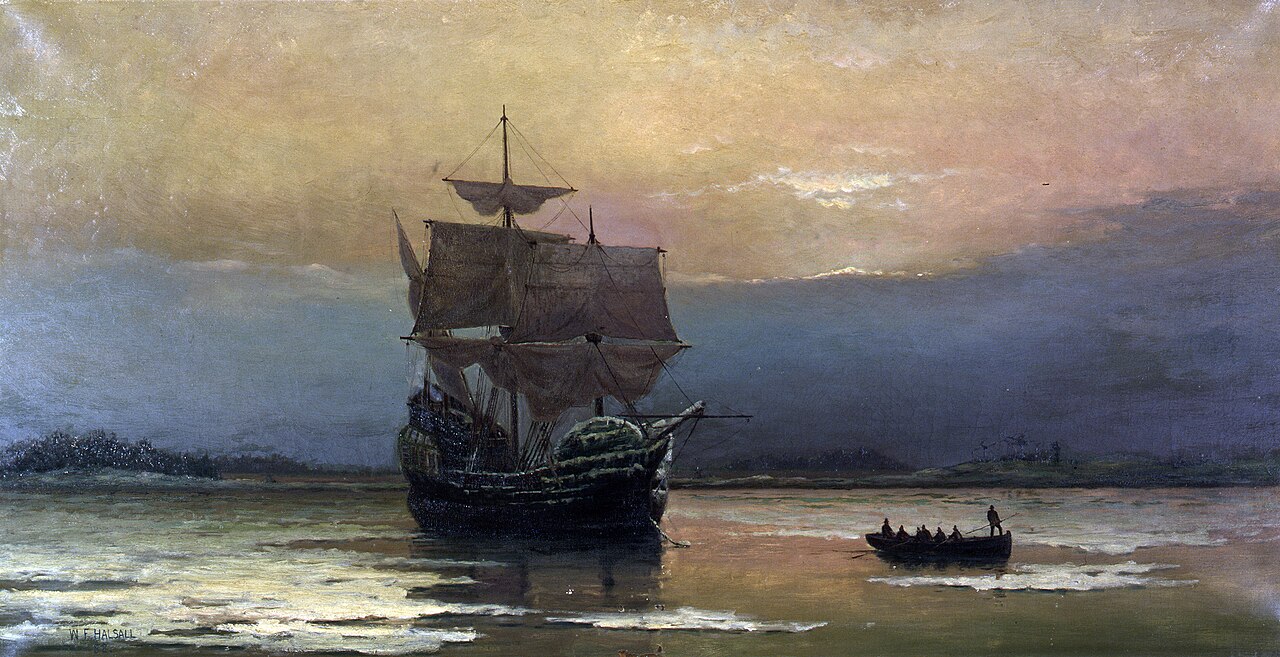
When the congregation resolved to send a first company to America in 1620, Robinson stayed behind with the majority, and those chosen to go first asked the Elder to go with them. He sailed on the Mayflower with his wife Mary and their two youngest sons, Love and Wrestling; their other children followed on later ships. He was among the men who signed the Mayflower Compact at Cape Cod on 11 November 1620. In the first winter, when half the company died, Bradford names him as one of only seven people still well enough to nurse the sick, men who “fetched them woode, made them fires, drest them meat, made their beads, washed their lothsome cloaths”, and who “were not at all infected either with sicknes, or lamnes” themselves.
At Plymouth he worked his own land like the other settlers, and “when the church had no other minister, he taught twise every Saboth, and yt both powerfully and profitably”. Bradford adds that for many years he lived without bread for months at a time and drank nothing but water. His wife Mary, whose maiden name has never been discovered, died on 17 April 1627; he did not remarry. In the division of the colony’s cattle a few weeks later, on 22 May 1627 (1 June in the modern calendar), his sons Love and Wrestling were counted in his lot. He later held land and a house at Duxbury, where Love lived from his marriage in 1634.
The couple had six known children: Jonathan, born at Scrooby on 12 August 1593; Patience and Fear, who married Thomas Prence and Isaac Allerton; the child buried at Leiden in 1609; and Love and Wrestling. Wrestling died unmarried before his father, and Bradford wrote in 1650 that the daughters who had come over after their parents were dead.
Death and estate
Bradford, who called him “my dear & loving friend”, describes his death in detail: he was ill only a short time, kept to his bed only on the last day, lost his speech about half a day before the end, and died about nine or ten in the evening, “in his bed, in peace, amongst ye mids of his freinds”. He was, Bradford wrote, “nere fourskore years of age (if not all out)”. He was buried at Plymouth.
He left no will. On 5 June 1644 the colony court granted administration of his estate to “his onely two sonnes surviveing”, Jonathan and Love, who swore to the inventory together. His goods at Plymouth were appraised by Captain Myles Standish and John Done on 10 May 1644, and those “at his house at Duxborrow” by Thomas Prence and Standish on 18 May; the same day Bradford, Prence and the Plymouth teacher John Reynor listed his Latin books, alongside a long list of English ones. The whole estate came to £150 0s 7d, of which the books made up £42 19s 11d. An address reprinted in the 1908 Brewster genealogy puts the library at about four hundred volumes, among them sixty-two in Latin and ninety-eight commentaries on or translations of the Bible, as identified by the historian Henry M. Dexter.
On returning from their father’s burial to Bradford’s house, the two sons agreed before the ministers of Duxbury, Plymouth and Marshfield to divide the estate peaceably, and to abide by the award of four of their father’s “deere and auncient frends”: Bradford, Edward Winslow, Thomas Prence and Myles Standish. When they later disagreed over the Duxbury house and some debts, the four awarded Love the house, in which he had lived since his marriage, together with half the estate, finding that the Elder had promised it to Love and his wife Sarah on their marriage. Jonathan, “because hee was the first borne of his father”, was given “his fathers Armes” and a two-year-old heifer. A final division was made on 30 August 1645.
Notes
The year of his birth is uncertain. The Leiden statement of 1609 giving his age as 42 would place it in the second half of 1566 or the first half of 1567, and a genealogy of the Brewster family published in 1908 follows that reckoning; the Dictionary of National Biography (1886) suggested about 1560, on the strength of a statement by Nathaniel Morton, secretary of the colony, that he was eighty-four at his death. Bradford’s “nere fourskore” agrees best with 1566 or 1567. An 1864 article in the New England Historical and Genealogical Register by Henry M. Dexter reasons from the same 1609 statement to a birth in 1566 or 1567. The January 1564 date, once given here, comes from a Find a Grave memorial; Dexter traces that year to Morton’s copy of Bradford in the Plymouth church records, an early chronicle rather than a record of his birth.
Bradford’s history places his death “aboute ye 18. of Aprill”; the family record kept by his son Jonathan, known as the Brewster Book, gives 10 April 1644, the date followed by the 1908 Brewster genealogy and in this account. The Brewster Book says he died “at Plymouth in New England”, which may mean the colony rather than the town, and his last years were divided between Plymouth and his house at Duxbury.
His English ancestry beyond his father is not known. Some published and online family trees extend the line back several generations into Yorkshire and Suffolk gentry, with titled wives; the 1908 Brewster genealogy and the works it relied on found no proof of his father’s origin, and those earlier generations are not followed in this account.
Family time line
Stories
Recorded events
| Event | When | Where | Evidence ?on record - the record itself, its image, or a transcript or printed copy of it has been read from a compiled source - an index, a printed genealogy or a memorial page says so not yet documented - in the family record, no source attached yet |
|---|---|---|---|
| Birth | abt 1566 | Scrooby, Bassetlaw District, Nottinghamshire, England | on record |
| Death | 10 Apr 1644 | Duxbury, Plymouth Colony, British Colonial America | from a compiled source |
| Burial | Plymouth, Plymouth, Massachusetts, United States | from a compiled source |
Sources
- U.S., Find a Grave® Index, 1600s-Current — Birth, Death, Burial, name
- Dexter, Rev. Henry M. "The True Date of the Birth and Death of Elder Brewster", NEGHR Vol. 18, pages 18-20 (Jan 1864) — Birth, about this person
- Anderson, Robert Charles. The Great Migration Begins: Immigrants to New England 1620-1633, vol. 1 - WILLIAM BREWSTER — Birth
- "Autographs of William Brewster" Proceedings of the Massachusetts Historical society — about this person
- "Mayflower Families Through Five Generations, William Brewster" , by Barbara Lambert Merrick and Scott Andrew Bartley, vol. 24. Plymouth, 2014. — about this person
- "The Brewster genealogy, 1566-1907", by Jones — about this person
- <Unknown>, "BillionGraves Index" — about this person
- Appletons' Cyclopedia of American Biography, 1600-1889, vol I, p. 371 — about this person
- Biography from History of 'Plimoth Plantation', Project Gutenberg E-text, p 487 (search for 487), with wrong date of death. Easier to read, more closely follows original, but no footnotes. — about this person
- Bowman, George E. "The Brewster Book", The Mayflower Descendant. Vol. 1, no. 1, Jan 1899, pages 1-9. — about this person
- Dictionary of National Biography, Volumes 1-22 — about this person
- Dictionary of National Biography to 1900, vol. 6, p. 304-305 — about this person
- “William Brewster’s Subterfuge”, The Mayflower Descendant, vol 66, #1 p 14 — about this person
- The Brewster Genealogy by Emma C. Brewster Jones, 2 links — about this person
- Signers of the Mayflower Compact — about this person
- The Great Migration Begins, p 227 — about this person
- The Beginnings of New England, by John Fiske, p. 81 — about this person
- Plymouth. Deeds 1686–1697 — about this person
- Records of the Colony of New Plymouth in New England (1620-1691), Shurtleff, Nathaniel B. & Pulsifer, editors, Boston; 1855-61, Page number: volume 8, page 187-196, This should have multiple citations with links — about this person
Borders as they stood about 1600 (they follow the event under the mouse), from the historical-basemaps project, the Newberry Library's Atlas of Historical County Boundaries (states and territories, 1783 on) and Natural Earth; the colonies and provinces are drawn along today's lines.
Line of descent
- William Brewster –1590
- William Brewster 1505–
- Maude Mann 1510–1558
- Unknown Mann 1470–
- not yet known
- Mary Smythe 1538–
Descendants
- Jonathan Brewster 1593–1659
- Mary Brewster 1627–1698
- Jonathan Turner 1646–1724
- Isaac Turner 1682–1770
- Ezekiel Turner 1650–1703
- Lucretia Turner 1701–1764
- John Turner 1654–1706
- Deborah Turner 1704–1786
- Jonathan Turner 1646–1724
- Ruth Brewster 1631–1677
- Mercy Pickett 1660–1725
- Mercy Fosdick 1686–1754
- Mercy Pickett 1660–1725
- Elizabeth Brewster 1637–1708
- Hannah Bradley 1656–1725
- Hannah Lester 1685–1768
- Hannah Bradley 1656–1725
- Mary Brewster 1627–1698
- Patience Brewster 1600–1634
- Rebecca Prence 1627–1651
- Patience Freeman 1647–1738
- Doroti Burge 1670–1725
- Rebecca Freeman 1651–1738
- Mary Perry 1675–1741
- Patience Freeman 1647–1738
- Hannah Sparrow Prence
- Thomas Mayo
- Judah Mayo 1691–1760
- Thomas Mayo
- Mercy Prence –1711
- Edmund Freeman 1657–
- Mary Freeman 1684–1747
- Bennett Freeman 1670–1716
- Mercy Paine 1712–1774
- Edmund Freeman 1657–
- Rebecca Prence 1627–1651
- Fear Brewster 1600–1634
- Isaac Allerton 1630–1702
- Sarah Allerton 1670–1731
- Ann Lee 1702–1739
- Elizabeth Lee 1709–1753
- Sarah Allerton 1670–1731
- Isaac Allerton 1630–1702
- Love Brewster abt 1612–bef 1651
- Wrestling Brewster 1644–1696
- Mary Brewster abt 1678–1761
- Joseph Holmes 1697–
- Ephraim Holmes 1699–
- Mary Holmes 1701–
- Sarah Holmes 1703–
- Abigail Holmes 1705–
- Jonathan Holmes 1709–1787
- Micah Holmes 1714–
- Keziah Holmes 1719–
- Wrestling Brewster 1695–
- Sarah Brewster
- Elizabeth Stetson 1709–1766
- Abigail Brewster
- Hannah Brewster
- Elizabeth Brewster
- Ezekiel Bradford 1728–1816
- Jonathan Brewster
- Mary Brewster 1713–1768
- Jerusha Brewster 1719–1795
- John Brewster
- Mary Brewster abt 1678–1761
- Nathaniel Brewster
- William Brewster
- William Brewster 1683–1768
- Ichabod Brewster 1710–1797
- Benjamin Brewster 1688–1752
- William Brewster 1714–1801
- Simon Brewster 1720–1801
- William Brewster 1683–1768
- Sara Brewster
- Benjamin Bartlett 1658–
- Priscilla Bartlett 1697–1758
- Benjamin Bartlett 1658–
- Wrestling Brewster 1644–1696